
Introduction to Artificial Intelligence (AI)
Definition of Artificial Intelligence (AI)
Artificial Intelligence (AI) refers to the simulation of human intelligence in machines that are programmed to think, learn, reason, and make decisions. AI systems can perform tasks that typically require human intelligence, such as problem-solving, language understanding, pattern recognition, and decision-making. These systems use algorithms, data, and computing power to analyze information and improve their performance over time.
Importance of AI in the Modern World
AI has become one of the most transformative technologies of the 21st century. It helps organizations automate repetitive tasks, increase efficiency, reduce costs, and improve accuracy. AI is widely used in healthcare, education, finance, transportation, agriculture, and many other sectors. By enabling faster data analysis and smarter decision-making, AI contributes to innovation and economic growth while improving the quality of life for people around the world.
Brief Overview of AI’s Growing Influence
The influence of AI continues to expand as technology advances. From virtual assistants and recommendation systems to self-driving vehicles and medical diagnosis tools, AI is becoming an integral part of everyday life. Businesses rely on AI to enhance customer experiences, governments use it to improve public services, and researchers apply it to solve complex global challenges. As AI evolves, it is expected to play an even greater role in shaping the future of society, industry, and technology.
History of Artificial Intelligence
Origins of AI
Early Concepts and Ideas
The concept of Artificial Intelligence (AI) can be traced back to ancient myths and stories that imagined intelligent machines and artificial beings. However, the scientific foundation of AI emerged in the mid-20th century with the development of computer science and computational theory.
The Birth of AI as a Field
In 1950, Alan Turing proposed that machines could simulate human intelligence and introduced the concept of the Turing Test. In 1956, John McCarthy coined the term “Artificial Intelligence” during the Dartmouth Workshop, marking the official beginning of AI as an academic discipline.
Key Milestones in AI Development
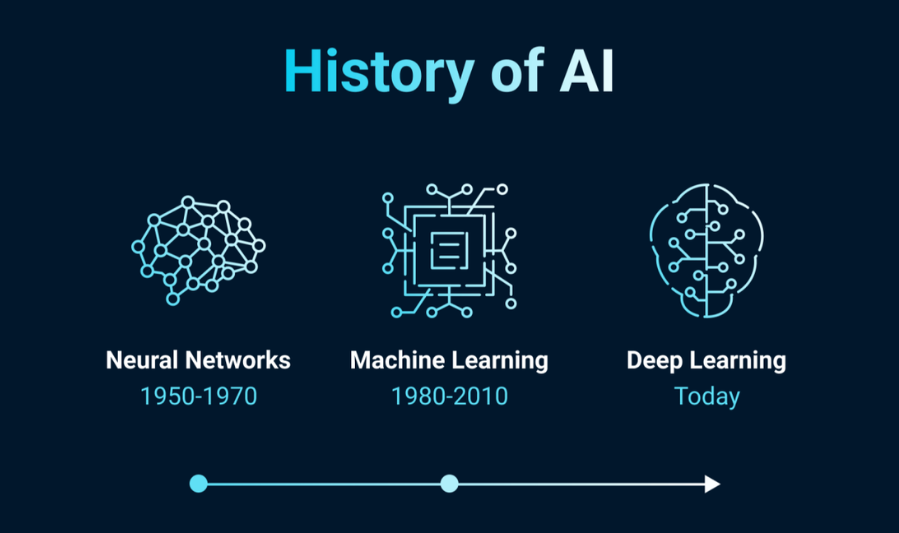
Early Research and Development (1950s–1970s)
Researchers developed the first AI programs capable of solving mathematical problems, proving logical theorems, and playing simple games. These achievements demonstrated the potential of machines to perform tasks associated with human intelligence.
Rise of Expert Systems (1980s)
During the 1980s, expert systems became widely used. These systems relied on large sets of rules and knowledge provided by human experts to make decisions in specialized fields such as medicine and business.
Major Breakthroughs (1990s–2010s)
- 1997: IBM’s Deep Blue defeated world chess champion Garry Kasparov.
- 2011: IBM’s Watson won the quiz show Jeopardy!.
- 2010s–Present: Advances in machine learning and deep learning revolutionized fields such as speech recognition, computer vision, and natural language processing.
Evolution from Rule-Based Systems to Machine Learning

Rule-Based AI Systems
Early AI systems operated using predefined rules and logical instructions created by programmers. These systems could perform specific tasks effectively but lacked the ability to learn from experience or adapt to new situations.
Emergence of Machine Learning
Machine learning introduced a new approach in which computers learn patterns from data instead of relying solely on manually programmed rules. This allowed AI systems to improve their performance over time and handle more complex tasks.
Deep Learning and Modern AI
Deep learning, a subset of machine learning, uses artificial neural networks to process large amounts of data. This technology has enabled significant advances in image recognition, language translation, autonomous vehicles, virtual assistants, and generative AI applications.
Impact of the Evolution
The transition from rule-based systems to machine learning has made AI more accurate, flexible, and capable of solving real-world problems. Today, AI continues to evolve and plays a crucial role in industries such as healthcare, finance, education, transportation, and entertainment.
How Artificial Intelligence Works
3.1 Machine Learning
Definition and Concepts
Machine Learning (ML) is a branch of Artificial Intelligence (AI) that enables computers to learn from data and improve their performance without being explicitly programmed for every task. Instead of following fixed rules, machine learning algorithms identify patterns, make predictions, and adapt based on experience. The more data an algorithm processes, the better it becomes at performing specific tasks.
Types of Machine Learning
Supervised Learning
Supervised learning uses labeled data to train models. The algorithm learns from input-output pairs and predicts outcomes for new data. Examples include email spam detection and house price prediction.
Unsupervised Learning
Unsupervised learning works with unlabeled data. The algorithm identifies hidden patterns, relationships, or groupings within the data. Customer segmentation and market basket analysis are common applications.
Reinforcement Learning
Reinforcement learning involves an agent learning through trial and error by interacting with its environment. The agent receives rewards for correct actions and penalties for incorrect ones. This approach is widely used in robotics, gaming, and autonomous systems.
3.2 Deep Learning
Neural Networks
Deep Learning is a specialized subset of machine learning that uses artificial neural networks inspired by the structure and functioning of the human brain. These networks consist of interconnected layers of nodes, or neurons, that process and analyze data. Deep learning models can automatically learn complex patterns from large datasets, making them highly effective for tasks such as image recognition, speech processing, and language translation.
Real-World Applications
Deep learning is used in numerous real-world applications, including:
- Self-driving vehicles that interpret road conditions and traffic signs.
- Voice assistants that understand and respond to spoken commands.
- Medical imaging systems that help detect diseases from X-rays and scans.
- Recommendation systems used by streaming and e-commerce platforms.
- Fraud detection systems in banking and financial services.
3.3 Natural Language Processing (NLP)
Language Understanding
Natural Language Processing (NLP) is a field of AI that focuses on enabling computers to understand, interpret, and generate human language. NLP combines computational linguistics with machine learning techniques to analyze text and speech. It allows machines to process language in a way that is meaningful and useful for human communication.
Chatbots and Virtual Assistants
NLP powers many applications that people use daily, including:
- AI chatbots that provide customer support and answer questions.
- Virtual assistants such as Siri and Google Assistant.
- Language translation tools that convert text between different languages.
- Speech recognition systems used in smartphones and smart devices.
- Sentiment analysis tools that evaluate customer opinions and feedback.
3.4 Computer Vision
Image and Video Recognition
Computer Vision is a branch of AI that enables computers to interpret and understand visual information from images and videos. Using machine learning and deep learning techniques, computer vision systems can identify objects, recognize patterns, detect movements, and analyze visual content with high accuracy.
Applications of image and video recognition include:
- Medical image analysis.
- Autonomous vehicle navigation.
- Security and surveillance systems.
- Quality control in manufacturing.
- Social media image tagging and content moderation.
Facial Recognition Technology
Facial recognition technology is a computer vision application that identifies or verifies individuals by analyzing unique facial features. The system compares facial characteristics with stored data to determine a person’s identity.
Facial recognition is commonly used in:
- Smartphone unlocking and device security.
- Airport and border security systems.
- Attendance monitoring systems.
- Law enforcement investigations.
- Access control for secure facilities.
While facial recognition offers convenience and enhanced security, it also raises important concerns regarding privacy, data protection, and ethical use.
Types of Artificial Intelligence
4.1 Narrow AI (Weak AI)
Definition
Narrow AI, also known as Weak AI, refers to AI systems designed to perform specific tasks within a limited domain. These systems operate under predefined constraints and cannot perform tasks beyond their programmed capabilities.
Characteristics
- Specialized in a single task or a limited set of tasks.
- Operates using predefined algorithms and learned patterns.
- Cannot transfer knowledge from one domain to another.
- Lacks self-awareness and human-like understanding.
Examples
Examples of Narrow AI include:
- Virtual assistants such as Siri and Google Assistant.
- Recommendation systems used by streaming and e-commerce platforms.
- Facial recognition systems.
- Spam email filters and language translation tools.
4.2 General AI (Strong AI)
Definition
General AI, also known as Strong AI or Artificial General Intelligence (AGI), refers to a theoretical form of AI that can understand, learn, and perform any intellectual task that a human being can accomplish. Unlike Narrow AI, General AI would be capable of reasoning, problem-solving, learning from experience, and adapting to different situations.
Characteristics
- Possesses human-level cognitive abilities.
- Can perform a wide variety of tasks across different domains.
- Learns and applies knowledge in new situations.
- Demonstrates reasoning, planning, and decision-making capabilities.
- Adapts independently to changing environments.
Current Status
General AI has not yet been achieved. Researchers and scientists continue to explore technologies that could eventually lead to AI systems with human-like intelligence and adaptability.
4.3 Super AI
Definition
Super AI refers to a hypothetical stage of artificial intelligence that surpasses human intelligence in all aspects, including creativity, reasoning, decision-making, emotional understanding, and problem-solving. This concept remains theoretical and has not been realized.
Characteristics
- Exceeds human intelligence in every cognitive domain.
- Processes information significantly faster than humans.
- Possesses advanced problem-solving and decision-making abilities.
- May be capable of self-improvement and independent innovation.
- Could potentially solve highly complex global challenges.
Future Possibilities
If Super AI becomes a reality, it could bring significant advancements in science, medicine, education, engineering, and environmental sustainability. It might accelerate discoveries, improve resource management, and help address complex societal issues.
However, Super AI also raises important concerns regarding safety, ethics, control, privacy, and the potential impact on employment and human decision-making. As a result, researchers emphasize the importance of developing responsible AI governance and safety measures alongside technological progress.
Comparison of AI Types
Narrow AI vs. General AI vs. Super AI
| Feature | Narrow AI (Weak AI) | General AI (Strong AI) | Super AI |
|---|---|---|---|
| Scope | Specific tasks only | Any human intellectual task | Beyond human intelligence |
| Learning Ability | Limited to trained tasks | Broad and adaptable learning | Highly advanced self-learning |
| Current Existence | Exists today | Theoretical | Hypothetical |
| Examples | Virtual assistants, recommendation systems | No real-world examples yet | No real-world examples yet |
| Intelligence Level | Task-specific | Human-level | Greater than human-level |
Conclusion
Artificial Intelligence can be categorized into Narrow AI, General AI, and Super AI based on its capabilities. While Narrow AI is widely used today, General AI and Super AI remain future possibilities. Understanding these categories helps researchers, businesses, and policymakers prepare for the opportunities and challenges that advanced AI technologies may bring.
Applications of Artificial Intelligence
Artificial Intelligence (AI) has become an essential technology across various industries, improving efficiency, accuracy, and decision-making. Its applications continue to expand as organizations adopt AI-driven solutions to solve complex problems and enhance productivity.
5.1 Healthcare
Disease Diagnosis and Detection
AI assists healthcare professionals in diagnosing diseases by analyzing medical records, laboratory results, and medical images. AI-powered systems can identify conditions such as cancer, heart disease, and neurological disorders with high accuracy.
Medical Imaging
AI helps analyze X-rays, MRI scans, and CT scans, enabling faster and more precise detection of abnormalities.
Personalized Treatment
AI can recommend customized treatment plans based on a patient’s medical history, genetic information, and health conditions.
Drug Discovery
Researchers use AI to accelerate the development of new medicines by analyzing vast amounts of biological and chemical data.
5.2 Education
Personalized Learning
AI enables personalized learning experiences by adapting educational content to individual student needs and learning styles.
Intelligent Tutoring Systems
AI-powered tutoring systems provide students with real-time feedback and guidance, helping them improve their understanding of subjects.
Automated Administrative Tasks
Educational institutions use AI to automate tasks such as grading assignments, managing student records, and scheduling classes.
Virtual Learning Assistants
AI-based virtual assistants help students access educational resources and answer academic questions.
5.3 Business and Marketing
Customer Service
Businesses use AI-powered chatbots and virtual assistants to provide 24/7 customer support and improve customer satisfaction.
Market Analysis
AI analyzes customer behavior, market trends, and purchasing patterns to help businesses make informed decisions.
Personalized Marketing
AI enables companies to deliver targeted advertisements and product recommendations based on customer preferences and online activity.
Sales Forecasting
Businesses use AI to predict future sales trends and optimize inventory management.
5.4 Finance and Banking
Fraud Detection
AI systems monitor financial transactions in real time to detect suspicious activities and prevent fraud.
Risk Assessment
Banks and financial institutions use AI to evaluate creditworthiness and assess financial risks.
Algorithmic Trading
AI-powered algorithms analyze market data and execute trades more efficiently than traditional methods.
Customer Support
AI chatbots assist customers with account inquiries, transactions, and financial guidance.
5.5 Transportation
Autonomous Vehicles
AI plays a crucial role in self-driving vehicles by enabling them to recognize road signs, detect obstacles, and make driving decisions.
Traffic Management
AI helps optimize traffic flow by analyzing traffic patterns and reducing congestion in urban areas.
Route Optimization
Logistics companies use AI to identify the most efficient routes, reducing fuel consumption and delivery times.
Predictive Maintenance
AI systems monitor vehicle performance and predict maintenance needs before breakdowns occur.
5.6 Agriculture
Precision Farming
AI helps farmers monitor crop health, soil conditions, and weather patterns to improve agricultural productivity.
Smart Irrigation
AI-powered irrigation systems optimize water usage by analyzing environmental conditions and crop requirements.
Pest and Disease Detection
AI can identify crop diseases and pest infestations early, allowing farmers to take preventive measures.
Agricultural Automation
Robots and AI-driven machinery assist with planting, harvesting, and crop monitoring.
5.7 Cybersecurity
Threat Detection
AI continuously monitors networks and systems to identify potential cyber threats and security breaches.
Malware Analysis
AI can detect and classify malicious software more quickly than traditional security methods.
Fraud Prevention
Organizations use AI to detect unusual user behavior and prevent unauthorized access to sensitive information.
Automated Security Response
AI-powered security systems can respond to threats automatically, reducing the impact of cyberattacks.
You may also like to read these posts:
Artificial Intelligence: Shaping the Future of Humanity
Understanding Machine Learning and Its Real-World Applications
5.8 Entertainment and Media
Content Recommendations
Streaming platforms use AI to recommend movies, music, and television shows based on user preferences and viewing history.
Content Creation
AI assists in generating text, images, videos, and music, supporting creative professionals and media organizations.
Gaming Industry
AI enhances video game experiences by controlling non-player characters (NPCs), improving game design, and creating adaptive gameplay.
Media Production
AI helps with video editing, special effects, animation, and content distribution, making media production more efficient.
Conclusion
Artificial Intelligence has transformed numerous industries by automating processes, improving decision-making, and enhancing user experiences. From healthcare and education to finance, agriculture, cybersecurity, and entertainment, AI continues to create innovative solutions that drive economic growth and technological advancement. As AI technology evolves, its applications are expected to become even more widespread and impactful in the future.
Benefits of Artificial Intelligence
Artificial Intelligence (AI) offers a wide range of advantages that are transforming industries, improving efficiency, and enhancing the quality of human life. By automating processes and analyzing large amounts of data, AI helps individuals and organizations achieve better results in less time.
Increased Productivity
AI systems can perform tasks faster and more efficiently than humans, allowing businesses and organizations to complete more work in less time. By handling large-scale data processing and repetitive operations, AI enables employees to focus on more complex and creative tasks.
Improved Accuracy
AI reduces human error by performing tasks with high precision. In fields such as healthcare, finance, and engineering, AI systems can analyze data and make predictions with greater accuracy than traditional methods, leading to more reliable outcomes.
Automation of Repetitive Tasks
AI is highly effective in automating routine and repetitive tasks such as data entry, scheduling, customer support, and report generation. This reduces workload for employees and increases overall efficiency in organizations.
Better Decision-Making
AI systems analyze large datasets quickly and identify patterns that may not be easily visible to humans. This helps organizations make informed decisions based on accurate insights, trends, and predictions.
Enhanced Customer Experience
AI improves customer experience through personalized recommendations, chatbots, and virtual assistants. Businesses can provide 24/7 support and tailor services according to customer preferences, leading to higher satisfaction levels.
Innovation and Economic Growth
AI drives innovation by enabling the development of new technologies, products, and services. It also contributes to economic growth by increasing productivity, creating new job opportunities, and improving efficiency across industries such as healthcare, transportation, and finance.
Conclusion
The benefits of Artificial Intelligence are vast and impactful. From improving productivity and accuracy to driving innovation and enhancing customer experience, AI plays a vital role in modern society. As technology continues to advance, its positive impact on industries and everyday life is expected to grow even further.
Faqs:
What is Artificial Intelligence (AI)?
Artificial Intelligence is a branch of computer science that enables machines to perform tasks that normally require human intelligence, such as learning, problem-solving, and decision-making.
How is Artificial Intelligence used in daily life?
AI is used in many everyday applications like mobile assistants (Siri, Google Assistant), social media algorithms, online shopping recommendations, and navigation systems.
Is Artificial Intelligence dangerous for jobs?
AI can automate some jobs, especially repetitive tasks, but it also creates new job opportunities in technology, data science, and AI development.
What are the main types of Artificial Intelligence?
There are three main types: Narrow AI (specific tasks), General AI (human-like intelligence), and Super AI (advanced future concept beyond human intelligence).
What is the future of Artificial Intelligence?
The future of AI is very promising. It is expected to improve healthcare, education, business, and many other fields while becoming more advanced and integrated into daily life.
Conclusion
Artificial Intelligence has become one of the most powerful and transformative technologies of the modern era. It is changing the way we live, work, and interact with the world by making systems smarter, faster, and more efficient. From healthcare and education to business and entertainment, AI is playing a major role in improving services and solving complex problems.
However, along with its benefits, AI also brings challenges such as job displacement, privacy concerns, and ethical issues that must be carefully managed. The key to a successful future with AI lies in responsible development, proper regulations, and the balanced use of technology.